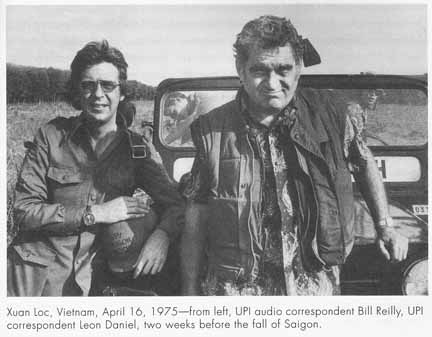
Xuan Loc, Vietnam, 4/16/1975, two weeks before fall of Saigon.
Leon Daniel - UPI Foreign Editor -- By Lewis Lord, with Al Kaff
____________________
Veteran UPI War Correspondent/Foreign Editor Daniel dead at 74 (March 19, 2006)
Leon Daniel, 74, a wire-service journalist who fought in one war and covered two more plus the civil rights revolution, died at a hospital in Glen Ellyn, Ill., from a blood clot in his lung Sunday night (March 19, 2006), five days after undergoing angioplasty.
Daniel spent 36 years with United Press International, working out of 11 bureaus on three continents before retiring in 1993 from its Washington headquarters. He twice was nominated for a Pulitzer Prize, once for his dispatches in the Vietnam War and a second time for work in the United States.
Leon Daniel, 74, a wire-service journalist who fought in one
war and covered two more plus the civil rights revolution, died
at a hospital in Glen Ellyn, Ill., from a blood clot in his lung
Sunday night (March 19), five days after undergoing angioplasty.
Daniel spent 36 years with United Press International, working
out of 11 bureaus on three continents before retiring in 1993
from its Washington headquarters. He twice was nominated for a
Pulitzer Prize, once for his dispatches in the Vietnam War and a
second time for work in the United States.
"Among wire service reporters, Leon Daniel was the gold
standard," said former UPI war correspondent Joseph
Galloway, his colleague in Saigon, Tokyo and New Delhi. "He
was a tough competitor," added former rival Peter Arnett,
who covered the Vietnam War for the Associated Press, "and
also was the most amiable of men, endearing him to colleagues and
soldiers alike."
Daniel was born in Etowah, Tenn., the son of a train dispatcher
and a school teacher, and grew up in Knoxville, Tenn. He enlisted
in the Marine Corps at 19 and became a rifle squad leader in the
Korean War. Returning home with a Purple Heart and an ankle
maimed by shrapnel, he attended the University of Tennessee on
the GI Bill, then jumped into journalism as a reporter at the
Knoxville Journal. He joined UPI in Nashville in 1956, became its
Knoxville manager in 1959, and went to Atlanta, UPI's Southern
headquarters, in 1960. For six years, he roamed the South,
reporting on the civil rights movement, the story he considered
the most important he ever reported.
In Philadelphia, Miss., he covered the search for three missing
(and murdered) civil rights workers. Philadelphia, he recalled,
was "a very dangerous town for any outsiders, not just civil
rights workers." On his first trip there, he and a New York
Times reporter stopped at a roadhouse for food. The Times
reporter, Daniel said, ordered "a pastrami on rye with
mustard or some impossible thing you could never get in the
South." Amid hostile stares, "we left in a hurry."
While vacationing in Florida in 1961, he got word that a group of
anti-Castro Cuban exiles--the Intercontinental Penetration
Brigade--was about to practice parachuting over an abandoned air
field near Fort Lauderdale. He and a photographer showed up, and
the brigade commander asked which of the two wanted to jump
first. They flipped a coin, Daniel would recall, "and I won,
or lost, depending on one's point of view." He wound up
leaping from a small plane at 2,500 feet. He landed on a concrete
runway and was dragged by high winds, an ordeal that busted the
ankle that was wrecked in Korea. He limped for the rest of his
life. UPI, forever frugal, refused to pay his medical costs.
Jumping from a plane during a vacation, the company explained,
was not an assignment.
In 1965, Daniel was in the Dominican Republic, witnessing a
rebellion. In 1966, he was reporting from the battlefronts of the
Vietnam War. One night, a mortar shell killed a young lieutenant
in a foxhole three feet from a hole in which Daniel and UPI
photographer Kyoichi Sawada slept unharmed.
In 1975, after a series of assignments across Asia from
Afghanistan to Okinawa, he was back in Vietnam, covering the fall
of Saigon. From the windows of the UPI bureau, he and bureau
manager Alan Dawson saw Communist tanks rumble victoriously
through the capital. "As darkness fell, we watched
ammunition dumps exploding in the distance and tracer bullets
leaping into the flare-lit sky," Daniel wrote. "As the
shooting subsided we awaited a visit to the bureau by the
victors. They never came. So, we ventured out into the street,
grinning at the Communist troops we'd only seen before on
battlefields. We were relieved when some of them grinned
back."
When the U.S. pulled out, nearly all the reporters left too. But
Daniel remained in Saigon. Weeks later, expelled by Vietnam's new
rulers, he showed up in Tokyo and was asked why he had stayed in
Saigon so long. "I had to," he said. "The AP
correspondent was there."
During the late 1970s, he served as UPI's Hong Kong-based editor
for Asia and then its London-based editor for Europe, the Middle
East and Africa. Among his overseas proteges was future New York
Times columnist Thomas Friedman, who applied with both AP and UPI
for a job in London. "AP said, 'Forget it, kid. You haven't
even covered a fire,' " Friedman later recalled, "but a
wonderful, grizzled, really, really fine newsman named Leon
Daniel . . . said, 'I'm going to take a chance on this kid.' So
Leon Daniel hired me and I learned how to be a journalist."
In 1977, while Daniel was vacationing in Knoxville, a rookie
answered the phone in UPI's Atlanta bureau and then shouted
across the newsroom: "Does anybody know a Leon Daniel? Says
he's got a hot story." Daniel's story turned out to be the
escape of Martin Luther King's assassin, James Earl Ray, from
East Tennessee's Brushy Mountain State Prison. After dictating a
bell-ringing story, Daniel rushed to the prison and for three
days helped put UPI on front pages across America.
In 1980, Daniel moved to Washington, where he would serve as
UPI's national reporter, roving the U.S. for news, then for two
years as its managing editor for international news. As its chief
correspondent in 1990, he flew to Kuwait to direct UPI coverage
of the Gulf War.
After retirement, Daniel continued to write. In an op-ed page
article in the Chicago Tribune last September, he said America's
"preemptive invasion [of Iraq] has landed the U.S. squarely
in the middle of a raging war that may prove unwinnable and bears
a remarkable resemblance to a Vietnam-style quagmire."
Daniel lived in Washington until 1997, when he moved to
Charlottesville, Va. Last summer, he and his companion for the
past 10 years, Judith Paterson, a retired journalism professor at
the University of Maryland, moved to Glen Ellyn, where his
daughter, the Rev. Dr. Lillian Daniel, is pastor of the First
Congregational Church. Other survivors include a grandson and a
granddaughter. His marriage to the late Carobel Calhoun Daniel
ended in divorce.
"He always said his obituary should say he was in
A.A.," said Paterson. "He was in it for the last 20
years." During most of his earlier years, he was a fan of
what he called "loudmouth soup."
Burial will be at Arlington National Cemetery, with a memorial
service to be held in Washington on April 1 at Christ Episcopal
Church on Capitol Hill.
__________________